
How to Choose Pouch-Grade Nonwoven Fabric for Heat Sealing
Summary: A practical B2B guide for choosing pouch-grade nonwoven fabric for heat sealing, including machine type, powder condition, GSM, sealing performance and sample testing.
Choosing pouch-grade nonwoven fabric for heat sealing is not only a material purchasing decision. It directly affects pouch appearance, sealing strength, production stability, fiber shedding, powder release and repeat-order consistency. For international buyers, the right selection should start from machine conditions and product requirements rather than from price alone.
1. Start with your machine and sealing method
Different pouch machines create different heat exposure, pressure and dwell time. A material that seals well on one line may require a different temperature window on another machine. Before selecting a grade, buyers should confirm whether the line uses intermittent flat-jaw sealing, continuous heat sealing or another sealing structure that requires sample testing.
- Intermittent flat-jaw sealing: usually needs material that can tolerate short heat shock and pressure.
- Continuous heat sealing: requires stable bonding behavior during repeated high-speed operation.
- Other sealing structures: should be confirmed by machine trial, powder behavior and pouch size.
2. Match the material to pouch speed
Machine speed changes the time available for heat transfer. Low-speed and mid-speed equipment may accept a wider material window, while high-speed equipment requires stronger consistency in fiber structure, sealing response and roll converting quality.
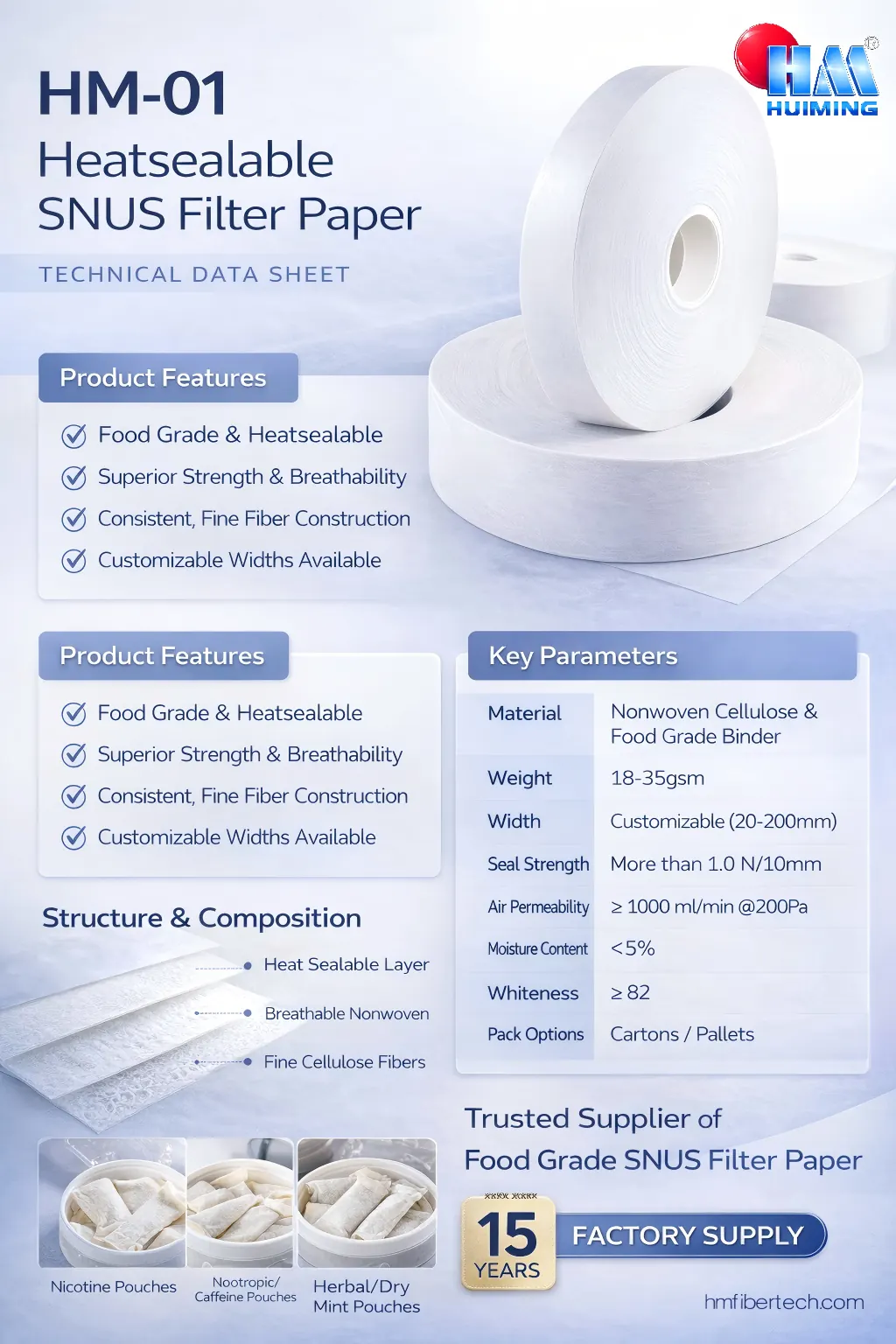
For mid-speed lines, a stable grade such as HM-A or HM-01 may be suitable depending on the sealing structure. For To be confirmed by machine trial high-speed projects, buyers usually need a premium grade with lower fiber shedding and tighter batch consistency, such as HM-XY.
3. Check GSM, pore size and air permeability together
GSM alone does not define performance. A pouch material also needs a suitable pore profile and air permeability. Huiming commonly supports 12–38 gsm customization, with many pouch projects using 25–35 gsm. Typical pore size can be around 70–90 μm, while air permeability may be adjusted within 500–1200 L/m²/s depending on the pouch application.
4. Consider powder moisture and dust behavior
Fine and very dry powders can create dust near the sealing jaws. This may reduce sealing stability and increase cleaning frequency. If the powder is extremely dry, formulation adjustment, machine parameter adjustment or another sealing structure may be considered after testing. If the powder contains moderate moisture or humectant, heat sealing may still work well after proper material and machine adjustment.
5. Ask for sample-roll testing before bulk purchase
Professional qualification should include sample rolls in the target slit width, machine testing, visual pouch review and sealing performance confirmation. A good supplier should also provide TDS, COA and SDS support where required.
Buyer checklist
- Application type: nicotine pouch, nootropic pouch, caffeine pouch, coffee pouch, botanical pouch or functional powder pouch
- Machine type and sealing method
- Target speed, such as To be confirmed by machine trial or To be confirmed by machine trial
- Slit width, roll length, outer diameter and core size
- GSM, softness, whiteness and low fiber shedding target
- Powder moisture, particle size and dust behavior
- Required documents: TDS, COA, MSDS/SDS, food-contact report if available, ISO/CE documents if applicable, or other files to be confirmed
Conclusion
The best pouch-grade nonwoven fabric for heat sealing is the material that matches your machine, powder condition, pouch width and target market. Send your machine details and sample requirement to Huiming, and we can recommend HM-A, HM-01 or HM-XY for testing before bulk supply.